
Chapter 1
Meet Mr. Ramesh
A common knee story, and the questions many patients ask.
Mr. Ramesh, 62, is a retired bank officer from Secunderabad. For two years his right knee hurt on the stairs. Last Diwali, he could not sit on the floor for pooja. A neighbour told him, “Grease is finished. Only operation now.” Worried, he came to the clinic.
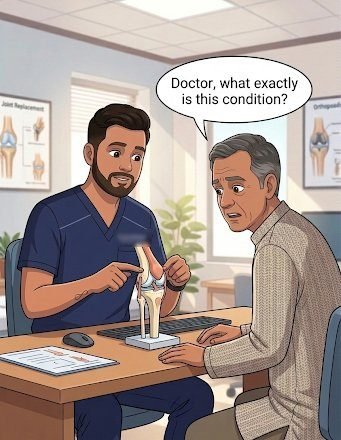

Mr. RameshDoctor, is my knee's grease really finished?
Dr. SumitNot finished, worn. The ends of your knee bones are covered by a smooth cushion called cartilage. In osteoarthritis (OA), this cushion slowly thins and cracks.

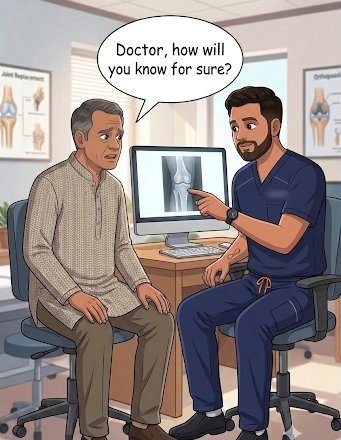
Mr. RameshThen why does my X-ray show a “gap”?
Dr. SumitCartilage does not show on an X-ray. That gap is your cartilage. Less gap means less cushion.
Knee pain does not automatically mean an operation. First understand what is happening inside your knee.
Chapter 2
Why me?
There is usually no single reason. Small damage adds up over the years.
Mr. RameshBut Doctor, I never fell or hurt my knee. Why me?
Dr. SumitUsually there is no single reason. Cartilage cannot repair itself well, so small damage adds up.
Mr. RameshI have three: age, weight and 30 years of floor sitting!
Dr. SumitAge we cannot change. But weight and habits are in your hands.
- AgeAbove 45
- HormonesWomen, especially after menopause
- Body weightExtra body weight
- HabitsYears of squatting, kneeling or sitting on the floor
- Old injuryLigament, meniscus or fracture
- AlignmentBow legs or knock knees
- FamilyFamily history
- Other joint diseaseRheumatoid arthritis, gout
Every 1 kg of extra body weight puts about 4 kg of extra load on your knee while walking. Lose 5 kg, and your knee carries about 20 kg less with every step.
Chapter 3
Is your knee talking to you?
Mr. Ramesh's knee gave warning signs for two years. Tick what you feel.
Check your knee
Sudden severe swelling, a red and hot knee with fever, knee locking, or you cannot stand on the leg.
Pain and X-ray do not always match. Treatment should consider you, not only your X-ray.
Chapter 4
Which grade is my knee?
OA is graded from 0 to 4 on a standing X-ray. The grade shows the changes in the joint. It does not, by itself, tell how much pain you feel.
Mr. RameshMy X-ray report says Grade 3. Is that very bad?
Dr. SumitLook at the dark gap between the bones on the X-ray. That gap is your cartilage.
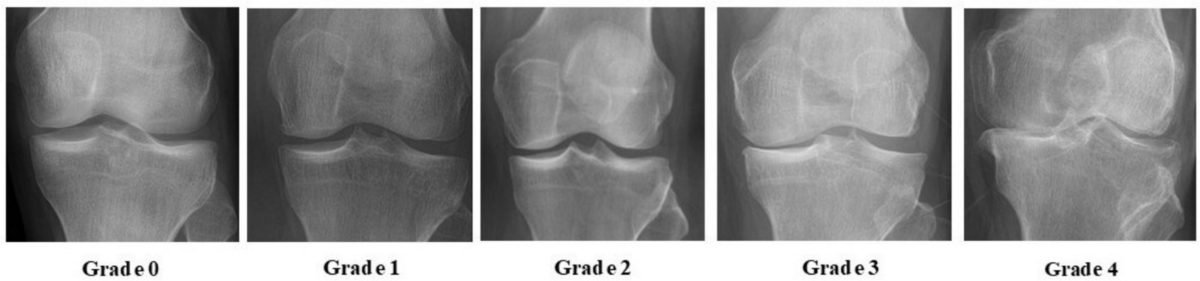
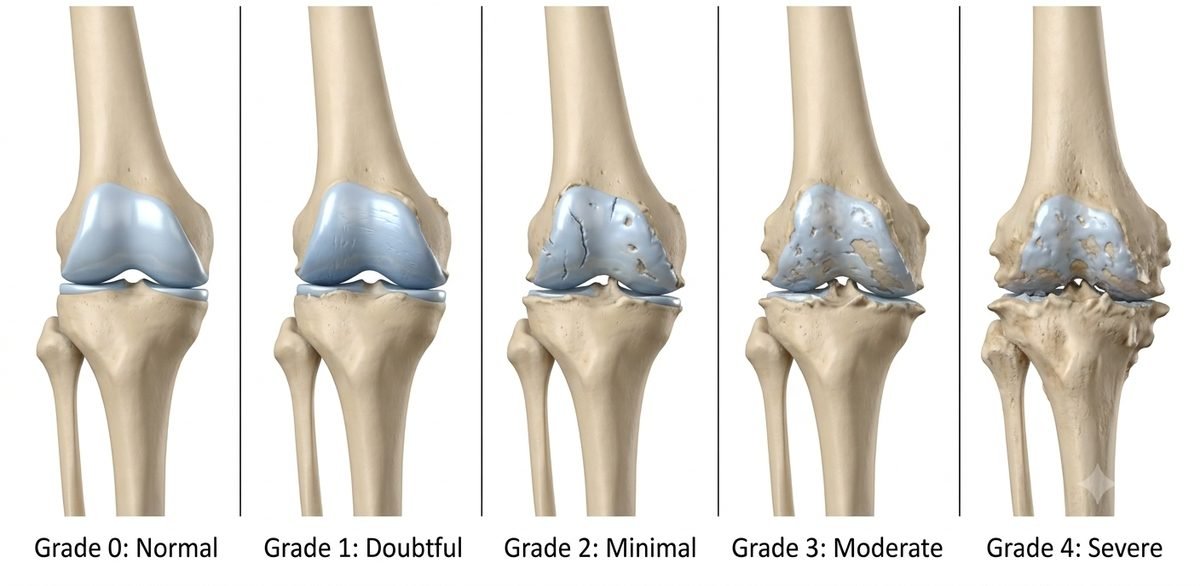
Look for the pattern: the joint space narrows, bone spurs grow, and in severe disease the joint space disappears.
| Grade | On X-ray | Inside the knee | Usual feeling |
|---|---|---|---|
| 0 · Normal | Normal gap, no spurs | Thick, smooth cartilage | No pain |
| 1 · Doubtful | Maybe a tiny spur | Cartilage softening | Mild ache after long walks |
| 2 · Mild | Clear spurs; gap may narrow slightly | Surface cracks and fraying | Pain on stairs; some stiffness |
| 3 · Moderate | Clear narrowing; many spurs; hard bone edge | Deep wear; bare bone patches | Daily pain; difficulty sitting on the floor |
| 4 · Severe | Gap gone; large spurs; leg shape changes | Cartilage fully worn; bone rubs on bone | Pain even at rest or at night; limp |
Several treatment options may still be possible, depending on your symptoms, daily function and the condition of your knee.
Chapter 5
Treatment is a ladder, not a single jump
We climb only as high as your knee needs, and try to save your own knee whenever possible.
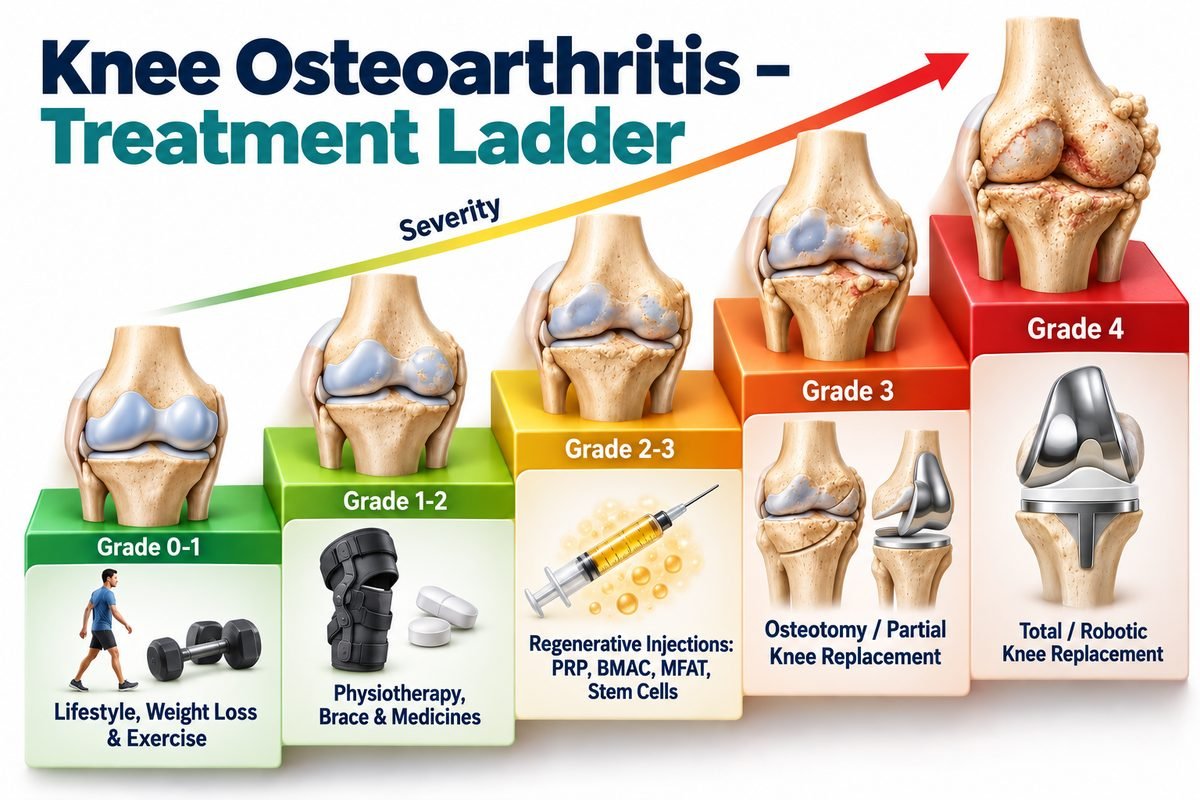
Lifestyle, weight loss and exercise
The foundation for everyone. Strong thigh muscles take load off your cartilage.
Physiotherapy, brace and medicines
The right exercises, knee support, and pain medicines only as advised. Long-term use of some pain medicines can harm the stomach and kidneys.
Regenerative injections
These injections use healing factors to calm inflammation, ease pain and support the cartilage you still have. They work only while some cartilage is left, so they are not advised in Grade 4.
Osteotomy or partial knee replacement
Osteotomy (HTO) realigns the bone in younger, active patients with bow legs, so weight shifts to the healthy side. Partial knee replacement replaces only the worn part.
Total or robotic knee replacement
The worn surfaces are replaced with metal and high-grade plastic. Robotic surgery gives more precise alignment. Most patients start walking with support from the next day.
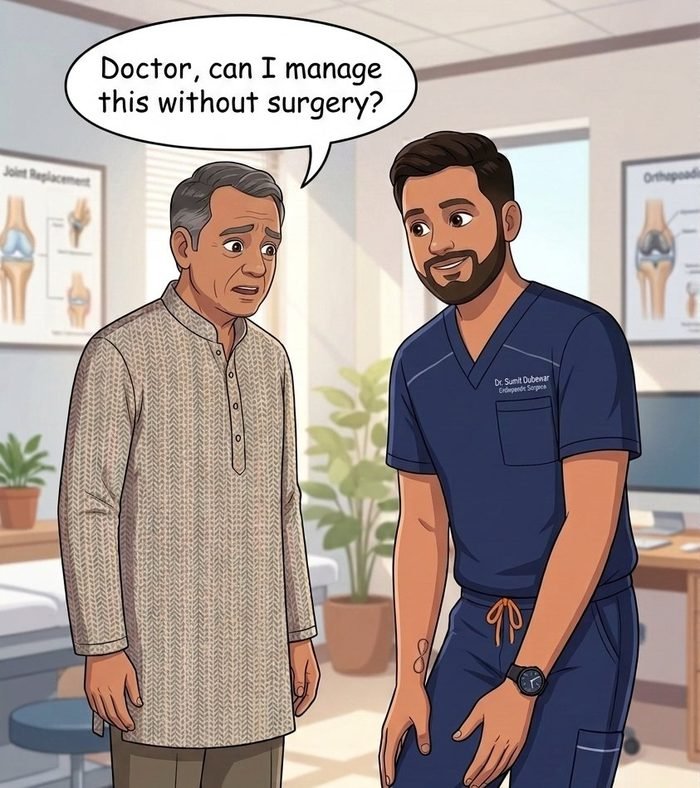
Mr. RameshDoctor, can I manage this without surgery?
Dr. SumitIn Grade 2 and 3, often yes. We combine exercise, weight control and regenerative injections to protect the knee you have.
Mr. RameshAnd if I need surgery one day, will I be in bed for months?
Dr. SumitNo. Most patients start walking with support from the next day.
Regenerative injections at a glance
| Therapy | Source | Knees covered |
|---|---|---|
| PRP (Platelet-Rich Plasma) | Your own blood | One or both |
| BMAC (Bone Marrow Aspirate Concentrate) | Your own bone marrow | Both knees |
| MFAT (Micro-Fragmented Adipose Tissue) | Your own fat tissue | Both knees |
| Stem cell therapy (DCGI Approved) | Donor (allogeneic) stem cells | One knee |
Steroid injections may give quick relief, but it lasts only a few weeks. Repeated injections can speed up cartilage damage and raise the risk of joint infection. That is why we do not use steroid injections for knee osteoarthritis.
Keyhole “cleaning” of the knee does not help arthritis pain in the long run.
Radiofrequency ablation (RFA) of knee nerves may be offered only to Grade 4 patients who are medically unfit for surgery. It switches off the pain signal but does not treat the knee. Without pain as a warning, the joint can get damaged faster. It is not an option before surgery for patients who are fit.
- X-ray grade
- Pain level
- Daily function
- Overall medical fitness
The right option is chosen for you, not from the X-ray alone.
The aim is not the biggest treatment. The aim is the right treatment, for the right knee, at the right time.
Myth vs fact
Simple-sounding advice can be misleading.
Myth“Grease is finished. Nothing can be done except operation.”
FactIn early grades, most knees improve without surgery.
Myth“Walking will wear out my knee faster.”
FactRegular walking on flat ground keeps cartilage healthy and muscles strong.
Myth“Steroid injection cures arthritis.”
FactIt gives short relief only. Repeated use can speed up cartilage damage.
Myth“Oil massage will bring back the grease.”
FactMassage may relax muscles, but it cannot rebuild cartilage.
Myth“After knee replacement, I will be in bed for months.”
FactMost patients walk with support from the next day.
Myth“My X-ray grade decides everything.”
FactYour pain and daily needs matter just as much.
Do's & don'ts for your knee
Small daily choices make a real difference to comfort and movement.
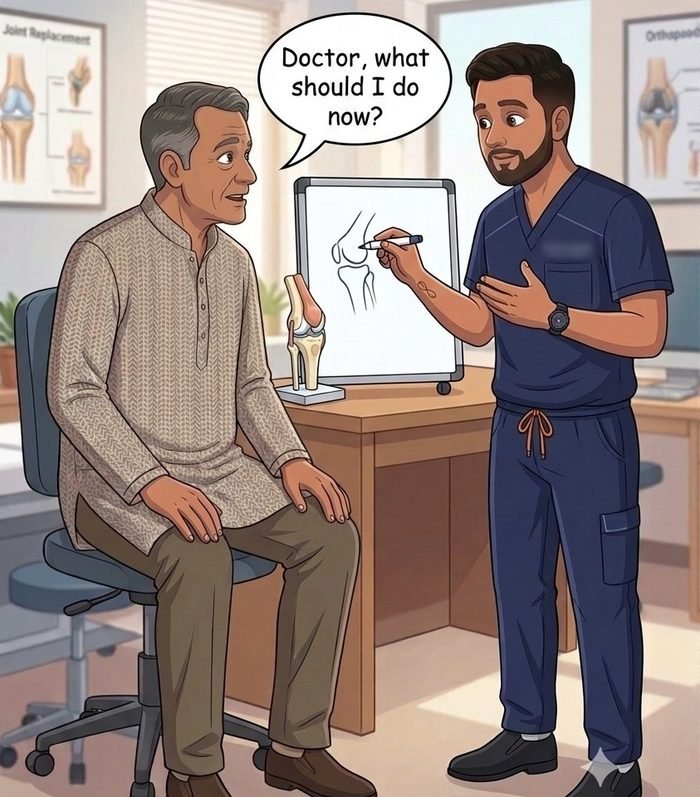
Do
- Walk 20–30 minutes daily on flat ground
- Do thigh-strengthening exercises daily
- Use a western toilet and a chair with arms
- Keep your weight in check
- Wear soft, cushioned footwear
- Cycle or swim
- Use a stick in the opposite hand on bad days
Don't
- Sit cross-legged on the floor for long
- Squat or use an Indian toilet
- Climb stairs again and again
- Take painkillers daily without advice
- Take steroid injections in the knee
- Run or jump on hard surfaces
- Ignore swelling, locking or night pain
Mr. Ramesh today
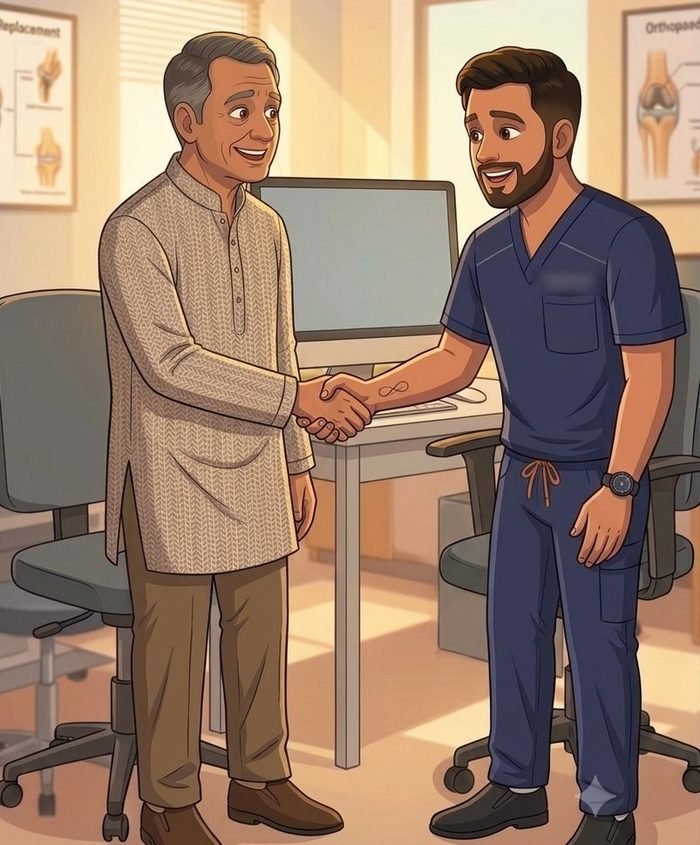
Mr. Ramesh lost 6 kg, started daily exercises and took regenerative injections for his Grade 3 knee. Today he climbs stairs with much less pain, and this Diwali he sat for pooja again.
Mr. Ramesh is an illustrative character. Results differ from person to person.
When should I meet the doctor?
Meet an orthopaedic surgeon if knee pain lasts more than 3 weeks, disturbs your sleep, or stops you from sitting on the floor or climbing stairs. Earlier treatment means more options to save your own knee.
- Standing X-ray of both knees (front and side view)
- Old reports
- Your current medicines
Common questions
What is knee osteoarthritis?
Knee osteoarthritis (OA) is wear of the cartilage, the smooth cushion covering the ends of the knee bones. It slowly thins and cracks, causing pain, stiffness and difficulty with stairs and floor sitting.
How is knee osteoarthritis graded?
On a standing X-ray, using the Kellgren–Lawrence system, from Grade 0 (normal) to Grade 4 (severe, bone on bone). The grade shows joint changes, not how much pain you feel.
Can knee osteoarthritis be treated without surgery?
Often yes, in Grade 0 to 3. Weight loss, exercise, physiotherapy, a brace and, in Grade 2–3, regenerative injections such as PRP, BMAC or MFAT can reduce pain and protect the knee.
Are steroid injections good for knee arthritis?
They give short relief of a few weeks. Repeated injections can speed up cartilage damage and raise infection risk, so we do not use them for knee osteoarthritis.
When is knee replacement needed?
Usually in Grade 4, when cartilage is fully worn and pain limits daily life. Most patients start walking with support from the next day after surgery.