Knee · Non-Surgical
Knee Pain Treatment Without Surgery in Secunderabad
Most knee pain can be managed without an operation. Stage-based care from an orthopaedic surgeon who does both non-surgical care and knee replacement — at ONE Healthcare Clinic, Tirumalagiri.
Book Clinic Appointment
Quick Answer
Can knee pain be treated without surgery?
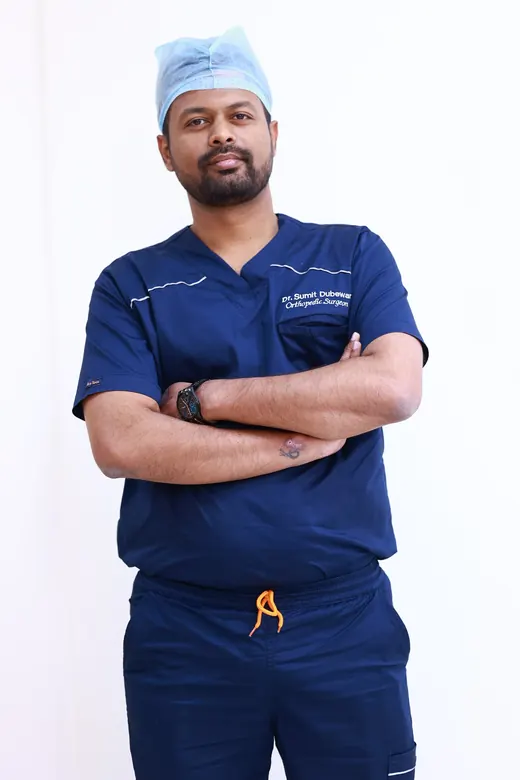
Yes — most knee pain does not need surgery. At ONE Healthcare Clinic, Tirumalagiri, Dr. Sumit Dubewar starts with a proper diagnosis (examination + standing X-ray), then a step-by-step plan: targeted exercise and physiotherapy, weight and activity changes, short courses of medicine, knee supports, and — for early-to-moderate (Grade 2–3) arthritis — PRP or other regenerative injections. Surgery is advised only when the knee is badly damaged or mechanically blocked.
Our step-by-step non-surgical approach
Treatment is built up in steps. Most patients improve on the first two or three steps; injections are added only when they are likely to help.
1
Diagnosis first
Examination, standing (weight-bearing) X-ray to grade any arthritis, and MRI only when it will change the plan. Blood tests (e.g., vitamin D, uric acid, inflammatory markers) when indicated.
2
Exercise & physiotherapy
Quadriceps, hip and core strengthening is the single most proven treatment for knee arthritis and kneecap pain. You get a home programme you can follow — see our knee exercise guide.
3
Weight, footwear & activity changes
Losing even 5–10% of body weight noticeably reduces knee load. Cushioned footwear, a walking stick in the opposite hand when needed, and reducing deep squatting and floor sitting during flare-ups.
4
Medicines — short and safe
Paracetamol, topical anti-inflammatory gels and short courses of tablets when appropriate, with attention to stomach, kidney and heart safety. Long-term painkiller use is avoided.
5
Regenerative injections (Grade 2–3 arthritis)
PRP injection prepared from your own blood, alone or with hyaluronic acid; for selected patients, bone-marrow (BMAC) or fat-derived (mFAT) concentrate. These aim to reduce pain and improve function — they do not regrow a worn-out joint. We do not use routine steroid injections for osteoarthritis.
Stage-wise Guidance
Which option fits which stage of knee arthritis?
| X-ray grade | What it means | Usual plan |
|---|
| Grade 1–2 | Early wear, joint space mostly preserved | Exercise, weight management, footwear; PRP considered for persistent pain at Grade 2 |
| Grade 3 | Moderate narrowing, bony spurs | All of the above; PRP / regenerative injection is a reasonable option to reduce pain and delay surgery |
| Grade 4 | Bone-on-bone, often with deformity (bow legs) | Injections are not recommended. Knee replacement usually gives the most reliable relief. For patients medically unfit for surgery, radiofrequency nerve ablation may be considered as a last resort — it reduces pain signals but does not treat the joint, and masking pain can allow further joint damage. |
Arthroscopic “washout” or “cleaning” of an arthritic knee is not recommended — good-quality studies show it does not help arthritis pain.
Safety
When knee pain may need surgery or urgent care
See a doctor promptly if you have:
- A hot, red, swollen knee with fever — possible infection (urgent, same day)
- A knee that locks and cannot be straightened
- Inability to bear weight, or a “pop” and rapid swelling after an injury
- Repeated giving way of the knee during sport or daily activity
- Severe pain at rest or at night, or a rapidly worsening deformity
When surgery is the better option, Dr. Sumit also performs robotic knee replacement and ACL reconstruction.
Your Visit
What happens at the clinic
ConsultationHistory, examination of both knees, hips and feet, and review of any previous reports.
ImagingStanding X-ray to grade the knee; MRI only if needed.
PlanA written, stage-appropriate plan with exercises, medicines and — if suitable — injection options and costs explained upfront.
Follow-upReview at about 4–6 weeks to check progress and adjust the plan.
हिंदी में
घुटने के ज़्यादातर दर्द का इलाज बिना ऑपरेशन के होता है — सही जाँच (एक्स-रे), व्यायाम, वज़न नियंत्रण, दवाइयाँ और ज़रूरत पड़ने पर Grade 2–3 गठिया में PRP इंजेक्शन। Dr. Sumit Dubewar, ONE Healthcare Clinic, तिरुमलगिरी, सिकंदराबाद।
తెలుగులో
చాలా రకాల మోకాలి నొప్పికి ఆపరేషన్ అవసరం లేదు — సరైన పరీక్ష (ఎక్స్-రే), వ్యాయామం, బరువు నియంత్రణ, మందులు, అవసరమైతే Grade 2–3 ఆర్థరైటిస్లో PRP ఇంజెక్షన్. Dr. Sumit Dubewar, ONE Healthcare Clinic, తిరుమలగిరి, సికింద్రాబాద్.
Get Your Knee Assessed
Suitability for any treatment is decided only after examination and a standing X-ray (MRI if needed). Convenient for patients from Tirumalagiri, Trimulgherry, Bolarum, Alwal, Lal Bazar, Karkhana, Malkajgiri, Sainikpuri, AS Rao Nagar, Kompally and the rest of Secunderabad and Hyderabad.
ONE Healthcare Clinic (OrthoRegen™), 21, Ravi Cooperative Society, Tirumalagiri, Secunderabad 500015 · Phone / WhatsApp: +91 93704 98182
Book Clinic Appointment
WhatsApp
This page is for patient education and does not replace an in-person consultation. Results of any treatment vary from person to person. Medically reviewed by Dr. Sumit Dubewar · Last reviewed 23 October 2026. Disclaimer