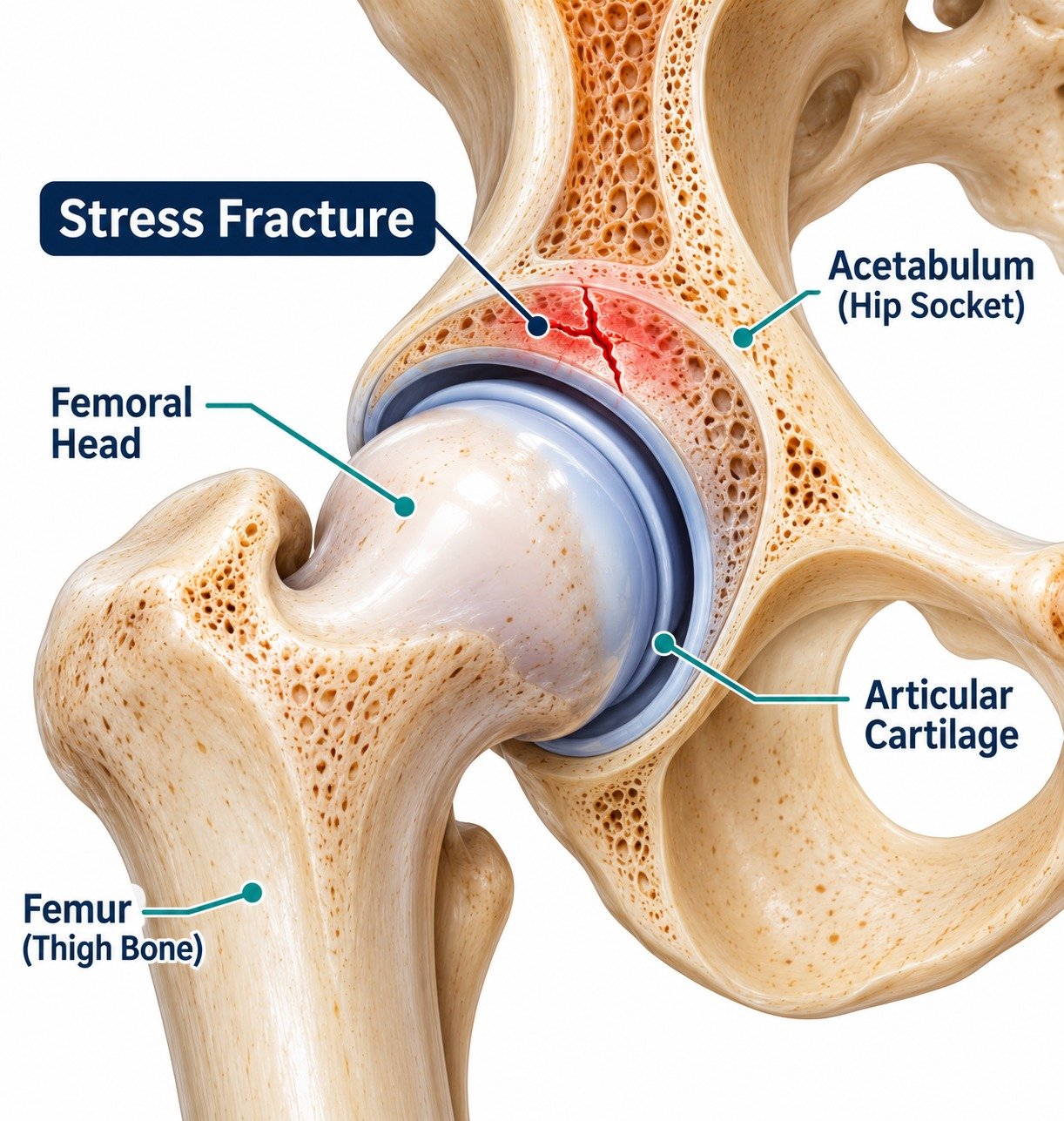
The acetabulum is the "socket" of the hip joint — it bears the full load of the body with every step, run and jump.
What Is It, and Why Does It Happen?
यह क्या है, और यह क्यों होता है?
ఇది ఏమిటి, మరియు ఇది ఎందుకు జరుగుతుంది?
A fatigue crack in bone, not a single-moment break
Bone is living tissue that constantly breaks down and rebuilds itself in response to the load placed on it — a process called remodeling. A stress fracture happens when repeated load breaks bone down faster than the body can rebuild it, so a tiny crack forms — not from one injury, but from the accumulated effect of thousands of smaller loads, like bending a paperclip back and forth until it snaps rather than breaking it in one go.
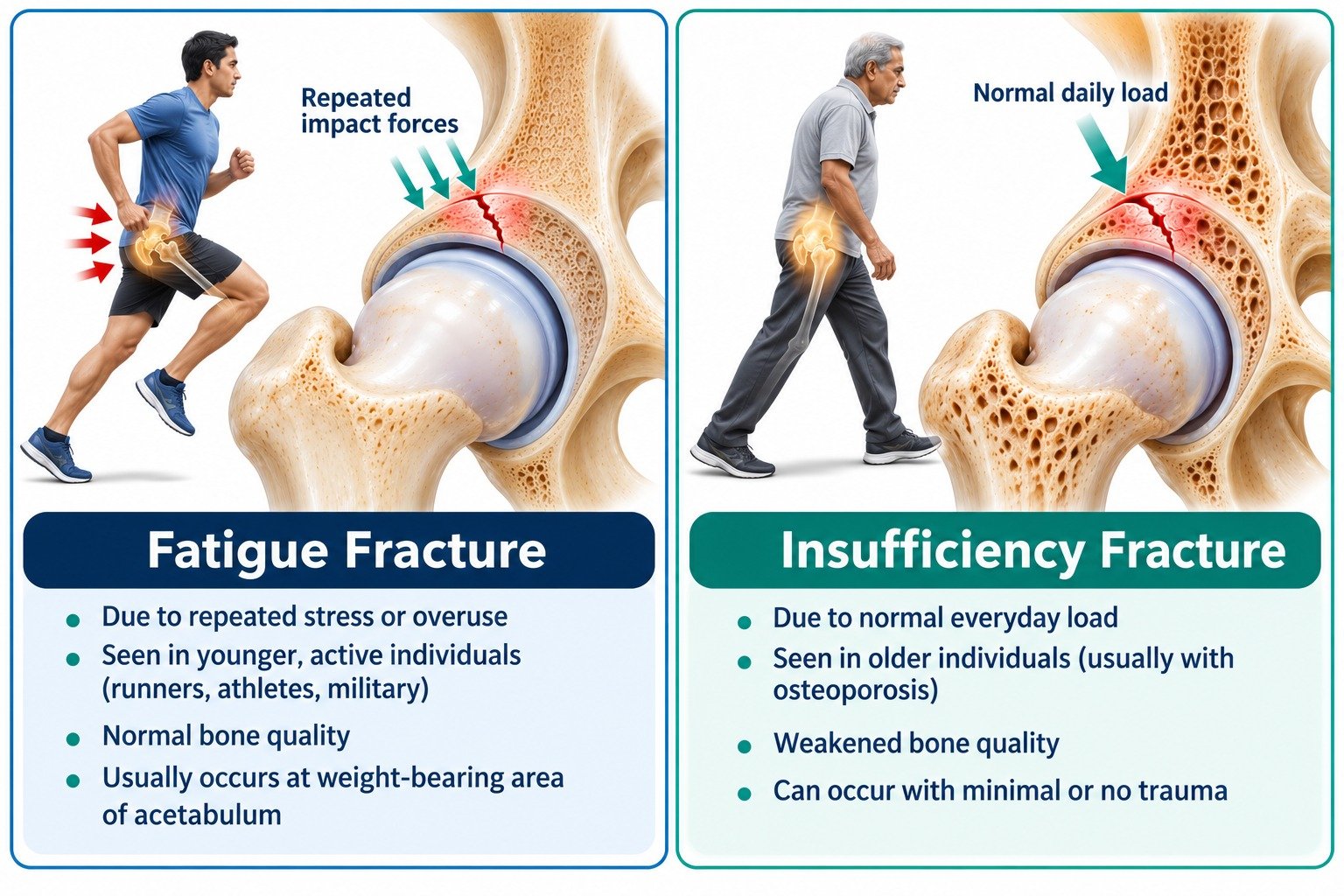
Two different roads to the same injury: abnormal repetitive load on normal bone, or normal everyday load on bone weakened by osteoporosis.
Doctors group stress fractures into two types, and the acetabulum can be affected by either:
- Fatigue fracture — normal, healthy bone subjected to abnormal, repetitive load. This is the type seen in long-distance runners, dancers, military recruits and athletes who suddenly increase their training volume, intensity or terrain
- Insufficiency fracture — normal, everyday load on bone that has been weakened, almost always by osteoporosis. This is the type seen in older adults, especially post-menopausal women, sometimes after nothing more than routine walking or a minor stumble
The acetabulum bears load with every single step, so it's a recognised — if relatively uncommon — site for both types, reported in distance runners and ballet dancers as a fatigue injury, and as part of pelvic insufficiency fractures in elderly patients with osteoporosis.
This is not the same as a traumatic acetabular fracture. A traumatic fracture happens instantly from a high-energy injury — a road traffic accident or a fall from height — and is a surgical emergency. A stress fracture builds up silently over weeks, usually with no memorable injury at all. Early X-rays are very often completely normal in a stress fracture; an MRI is the most reliable way to confirm it, especially in the first two to three weeks.
Symptoms
लक्षण
లక్షణాలు
Deep groin pain that builds up, without a clear injury
- Deep groin or hip pain that starts vaguely and gradually sharpens over days to weeks — rarely a single "snap" moment
- Pain that worsens with weight-bearing activity — walking, running, climbing stairs — and eases with rest, at least in the early stages
- If activity continues despite the pain, it can progress to hurting during ordinary daily activity, and eventually even at rest or at night
- Pain may be felt in the groin, front of the thigh, or buttock, and a limp often develops as the body tries to avoid loading the hip fully
- No history of a significant fall or injury in the classic athletic presentation — this is often the clue that points away from a simple strain or sprain
Seek urgent care if: you are completely unable to bear weight on the leg; an older or osteoporotic patient develops sudden severe hip pain after even a minor stumble (possible displaced fracture); or hip pain follows a high-energy injury such as a road traffic accident or a fall from height — this needs emergency evaluation for a traumatic acetabular fracture, a different and more serious injury from the one discussed in this article.
Treatment Options
उपचार के विकल्प
చికిత్స ఎంపికలు
Most heal well with rest alone — surgery is rare
First-Line Treatment (Most Cases)
प्राथमिक उपचार (अधिकतर मामले)
మొదటి-వరుస చికిత్స (చాలా సందర్భాలు)
- Unloading the joint — stopping the triggering activity completely, often with a period of protected, partial weight-bearing on crutches for several weeks, depending on pain and fracture location
- Pain control — paracetamol is generally preferred; anti-inflammatory painkillers (NSAIDs) are used cautiously, since some evidence suggests they may slow bone healing
- Fixing the underlying driver — a graded, supervised return to training after a sudden load increase; for female athletes with menstrual irregularity, low body weight or disordered eating, an evaluation for the female athlete triad / low energy availability; for older adults, a work-up for osteoporosis (DEXA scan)
If Healing Is Slow or Pain Persists
यदि हीलिंग धीमी हो या दर्द बना रहे
హీలింగ్ నెమ్మదిగా ఉంటే లేదా నొప్పి కొనసాగితే
- Extended protected weight-bearing, with repeat MRI or X-ray to confirm the fracture line has healed before returning to any impact activity
- Bone health optimisation — adequate calcium and vitamin D for everyone, and bone-strengthening medication where osteoporosis is confirmed
- Physiotherapy for hip and core strengthening once pain-free, addressing the gait pattern or muscle imbalance that may have contributed in the first place
When Surgery Is Needed
जब सर्जरी की ज़रूरत होती है
శస్త్రచికిత్స అవసరమైనప్పుడు
- Surgery is uncommon for acetabular stress fractures, reserved for fractures that fail to heal with adequate conservative care, show displacement, or threaten the weight-bearing joint surface
- When needed, options include internal fixation to stabilise the fracture and allow it to heal in the correct position
The overwhelming majority of acetabular stress fractures, diagnosed early and managed with appropriate unloading, heal completely with conservative treatment alone. Surgery is the exception, not the rule — the real risk is missing the diagnosis and continuing to load the joint, not the fracture itself.
Exercise & Return to Activity
व्यायाम और गतिविधि पर वापसी
వ్యాయామం మరియు కార్యకలాపానికి తిరిగి రావడం
A graded return protects the healing bone
Returning too early is the single biggest reason an acetabular stress fracture fails to heal or recurs. Once pain-free weight-bearing is confirmed, a structured, step-by-step progression — gentle hip and core strengthening before any running, jumping or impact sport — gives the fracture the best chance of healing completely and staying healed.
Hip-Friendly Strengthening Exercises
हिप-फ्रेंडली स्ट्रेंथनिंग व्यायाम
హిప్-ఫ్రెండ్లీ స్ట్రెంథెనింగ్ వ్యాయామాలు
Guided exercises for a safe return to activity
Dr. Sumit's Advice
डॉ. सुमित की सलाह
Dr. సుమిత్ సలహా
A word from Dr. Sumit
"Acetabular stress fractures are genuinely easy to miss — in a young runner, the pain gets labelled a groin strain for weeks because the first X-ray looks completely normal; in an older patient, it gets dismissed as 'just age-related hip pain.' Both groups keep loading a hip that needs to be unloaded. My advice is simple: if groin or hip pain in a runner or dancer isn't settling with a week or two of rest, or if an older patient develops new hip pain without a clear fall, ask for an MRI rather than waiting for a repeat X-ray to 'catch up.' Caught early, this heals very reliably without surgery — the damage usually comes from training or walking through it for months before anyone looks closely."
— Dr. Sumit Dubewar · DABRM (USA) · Secunderabad
Need Expert Advice?
विशेषज्ञ सलाह चाहिए?
నిపుణుల సలహా కావాలా?
Book a consultation with Dr. Sumit. Get an honest assessment and the right treatment plan.
Book Consultation 💬 WhatsApp