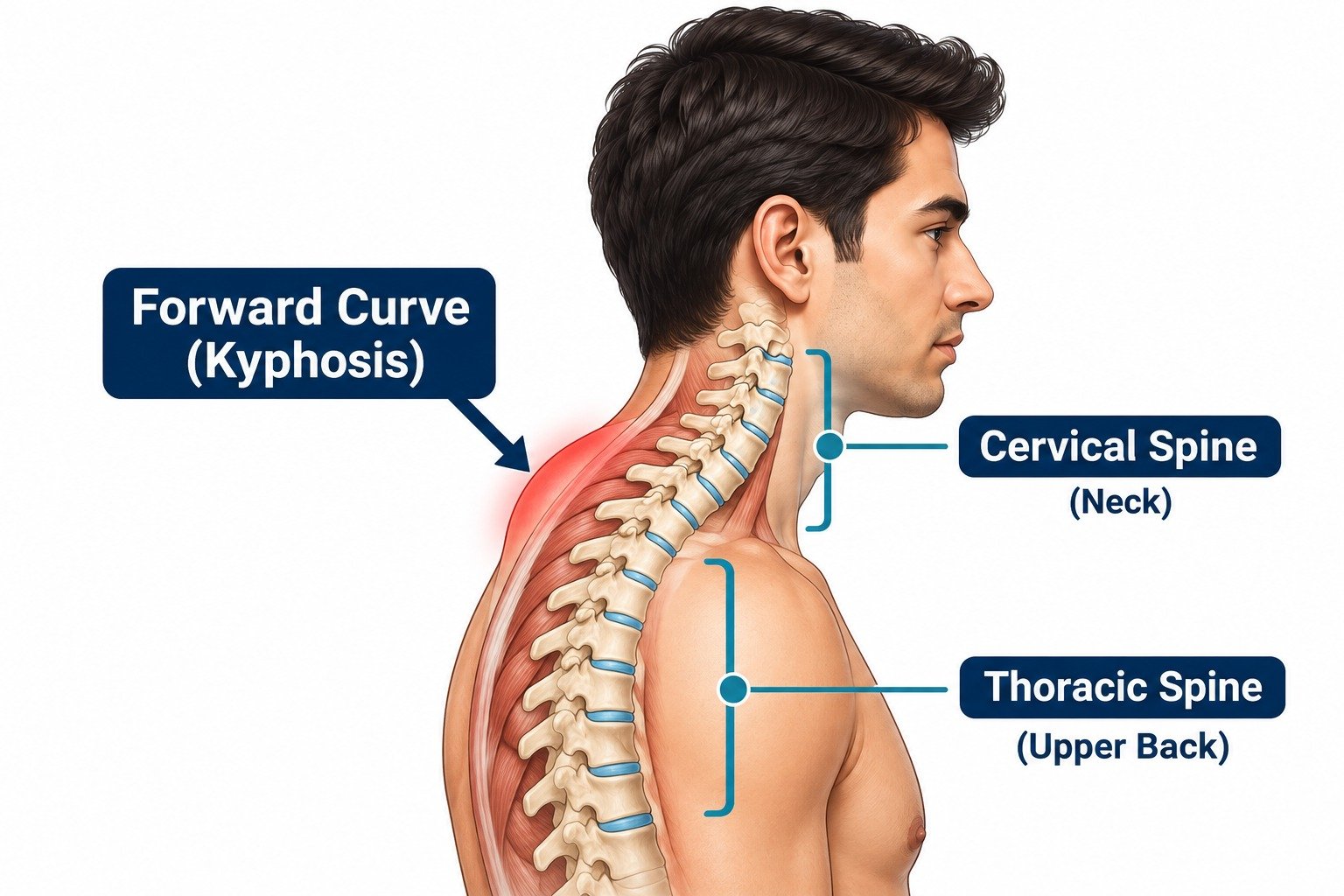
A dowager's hump is a forward curve of the spine at the base of the neck — most often from posture, sometimes from bone changes.
What Is It, and What Causes It?
यह क्या है, और इसका कारण क्या है?
ఇది ఏమిటి, దీనికి కారణం ఏమిటి?
Almost always a posture problem, occasionally a bone problem
A "neck hump" is a rounded, forward curve of the spine where the neck meets the upper back — doctors call this kyphosis. It usually becomes visible in middle age, and once it's there, people often assume it's permanent or purely an aging change. In reality, most cases are built up slowly, one factor at a time, and most can be improved.
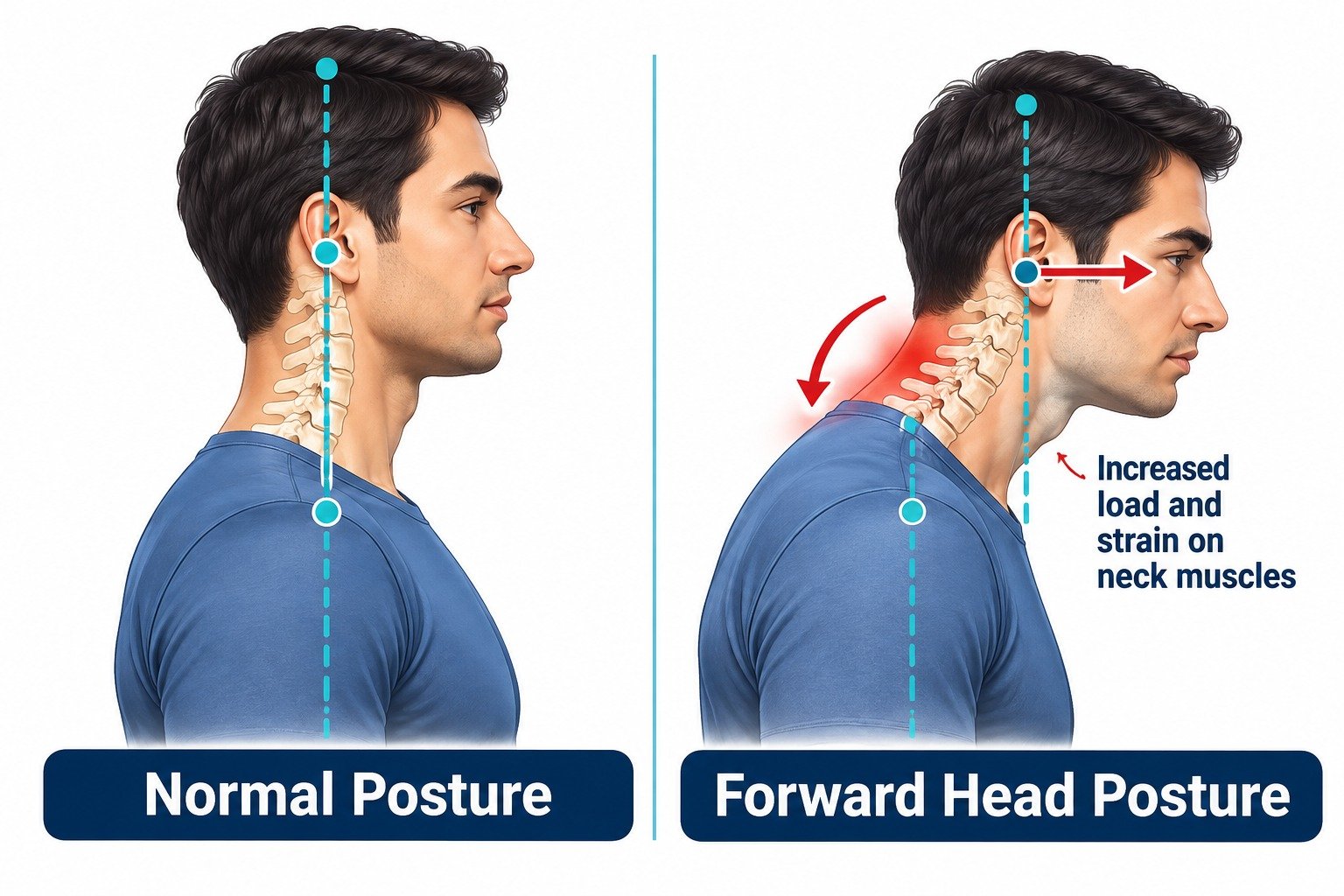
Every inch the head drifts forward of the shoulders multiplies the load the neck muscles and discs must bear — the main driver of a posture-related neck hump.
- Forward head posture ("text neck") — the most common cause by far. Hours spent looking down at phones and laptops, combined with weak upper-back muscles and tight chest/neck muscles, gradually pulls the head forward and rounds the upper spine
- Osteoporosis-related compression fractures — weakened vertebrae in the upper back can slowly compress and wedge forward, increasing the curve; this is more common in post-menopausal women due to the drop in bone-protecting hormones
- Degenerative spinal changes with aging — arthritis and gradual disc wear can slowly reshape the normal curve of the spine over years
- Less common causes — Scheuermann's kyphosis in teenagers (vertebrae develop a wedge shape instead of rectangular), congenital spine conditions, and rarely infections or tumors affecting the bone
Neck hump vs. buffalo hump: these are often confused but are different problems. A dowager's hump is bony — a true curve of the spine, from posture, osteoporosis, or disc changes. A buffalo hump is a soft fatty deposit at the back of the neck, usually linked to steroid medication use or Cushing's syndrome. The two can look similar and can even occur together, so a doctor's examination is the reliable way to tell them apart — treatment for one does nothing for the other.
Symptoms
लक्षण
లక్షణాలు
What to look for, and when it's more than cosmetic
- Rounded shoulders and a forward-jutting head when viewed from the side — often the first thing people notice in photographs or mirrors
- A visible curve or bump at the base of the neck, which becomes more noticeable when bending the head forward
- Neck and upper back stiffness or aching, usually worse by the end of a desk-bound day
- Tight hamstrings and chest muscles often accompany the rounded upper back, as poor posture affects the whole posterior chain, not just the neck
- Headaches, especially tension-type headaches starting at the base of the skull, from the constant muscle strain of holding the head up
- General fatigue from muscles working overtime to compensate for the shifted head position
See a doctor promptly if: you notice numbness, tingling or weakness spreading into the arms or hands; a pronounced curve is accompanied by breathing difficulty or reduced exercise tolerance (uncommon, but a sign of a severe, advanced curve); or the hump worsens suddenly, or new severe back pain appears, after a fall or minor trauma — this can signal a compression fracture that needs urgent evaluation.
Treatment Options
उपचार के विकल्प
చికిత్స ఎంపికలు
Most cases improve with consistent, targeted effort
First-Line Treatment
प्राथमिक उपचार
మొదటి-వరుస చికిత్స
- Posture and ergonomics correction — keeping phones and screens at eye level, raising a laptop on a stand, and taking a posture break every 30-45 minutes
- Targeted exercises — chin tucks, scapular (shoulder blade) squeezes, and doorway pectoral stretches done consistently, every day, retrain the muscles that hold the head and shoulders in a better position
- Physical therapy — if self-directed correction isn't making progress after several weeks, a physiotherapist can teach correct technique and build a structured, supervised program
If Osteoporosis Is the Underlying Driver
यदि ऑस्टियोपोरोसिस मुख्य कारण है
ఆస్టియోపొరోసిస్ ప్రధాన కారణమైతే
- A bone density test (DEXA scan) is recommended, especially for post-menopausal women or anyone with a new compression fracture, to measure how much bone strength has been lost
- Bone health medication, along with calcium and vitamin D optimization, helps slow further bone loss and reduce the risk of additional compression fractures
- Fall-prevention counseling — fall-proofing the home and using safe lifting technique matters more here, since a fall on already-weakened vertebrae can worsen the curve quickly
When the Curve Is Already Advanced
जब मुड़ाव पहले से ही बढ़ चुका हो
వంపు ఇప్పటికే ముదిరిపోయినప్పుడు
- A posture-support brace may be used in select cases to support the spine while underlying strength and bone health are being addressed
- Orthopedic or spine surgical consultation is reserved for rare, severe, fixed curves causing significant pain, nerve symptoms, or breathing compromise — surgery is uncommon for this condition and is not the first option considered
Most posture-related neck humps improve gradually with consistent exercise and ergonomic change — often over several months, not weeks. The earlier the underlying habit is corrected, the better and faster the long-term result.
Exercise & Movement
व्यायाम और हलचल
వ్యాయామం మరియు కదలిక
The single most effective, low-cost treatment for most cases
Because most neck humps are driven by posture, the muscles that correct it — the deep neck flexors, the muscles between the shoulder blades, and the chest muscles that need stretching, not strengthening — respond well to simple, repeatable daily exercises. Consistency matters far more than intensity here.
Neck Hump Exercises
नेक हंप व्यायाम
నెక్ హంప్ వ్యాయామాలు
4 guided posture-correction exercises
Dr. Sumit's Advice
डॉ. सुमित की सलाह
Dr. సుమిత్ సలహా
A word from Dr. Sumit
"Most patients who come to me worried about a neck hump assume it's fixed — that it's just 'how their body is now.' In the large majority of cases, that's not true. If the cause is posture, which it usually is, the hump responds to consistent chin tucks, scapular strengthening, and genuinely changing how you hold your phone and screen through the day — not overnight, but over a few months. The one thing I don't want patients to skip is ruling out osteoporosis, especially in women past menopause — a hump that has appeared with a new, sharp onset of back pain deserves an X-ray and a bone density check before anyone assumes it's 'just posture.'"
— Dr. Sumit Dubewar · DABRM (USA) · Secunderabad
Need Expert Advice?
विशेषज्ञ सलाह चाहिए?
నిపుణుల సలహా కావాలా?
Book a consultation with Dr. Sumit. Get an honest assessment and the right treatment plan.
Book Consultation 💬 WhatsApp