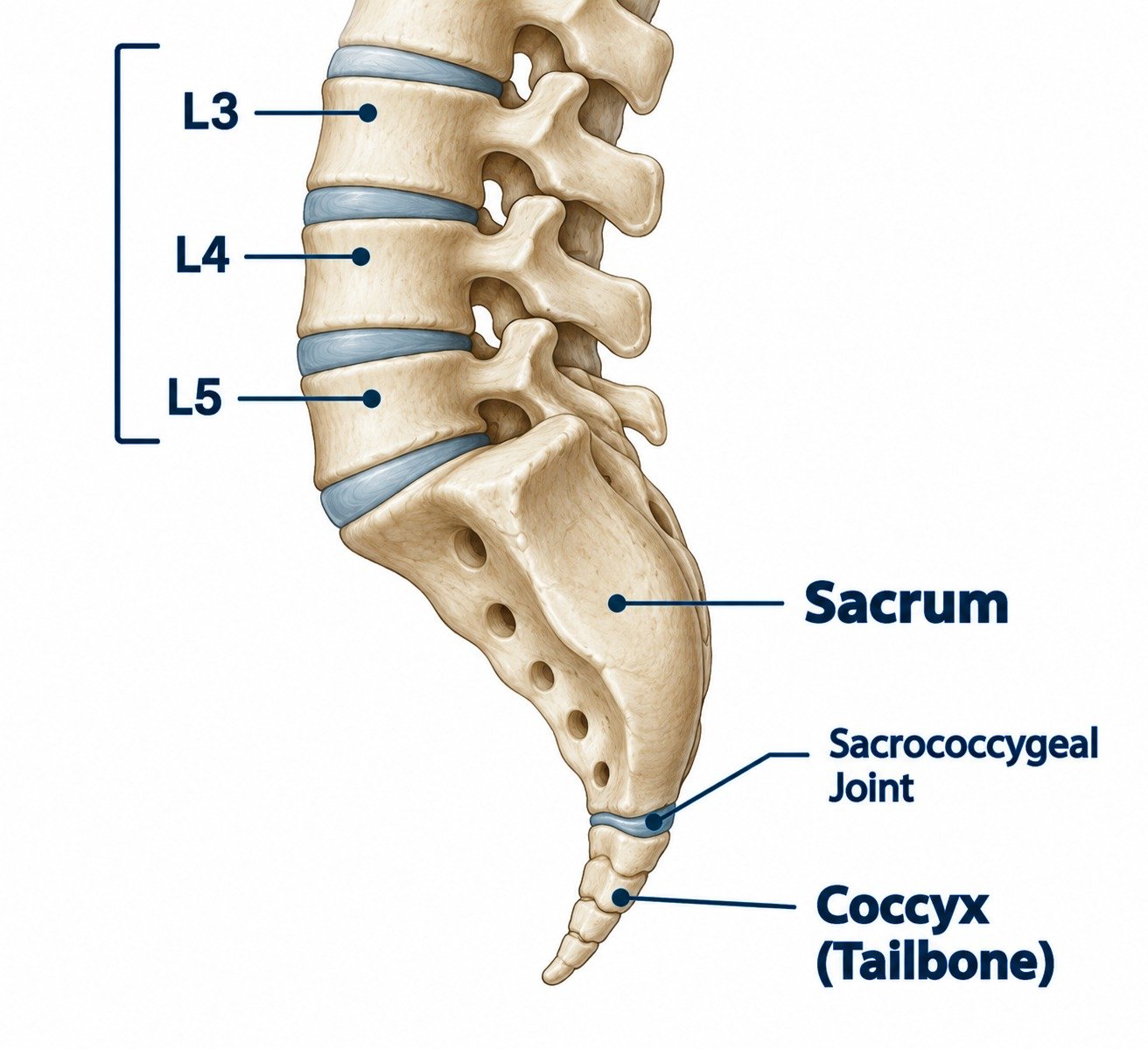
The coccyx sits at the very base of the spine, below the sacrum, and normally flexes slightly when you sit.
Why Does This Happen?
यह क्यों होता है?
ఇది ఎందుకు జరుగుతుంది?
Causes and what is actually going wrong at the tailbone
The coccyx (tailbone) is the small, triangular set of 3–5 bony segments at the very bottom of your spine, below the sacrum. It normally flexes slightly backward when you sit, acting as one of three points of weight-bearing support (along with your two sitting bones). Coccydynia happens when that small joint or the surrounding ligaments and muscles become irritated, injured, or move abnormally.
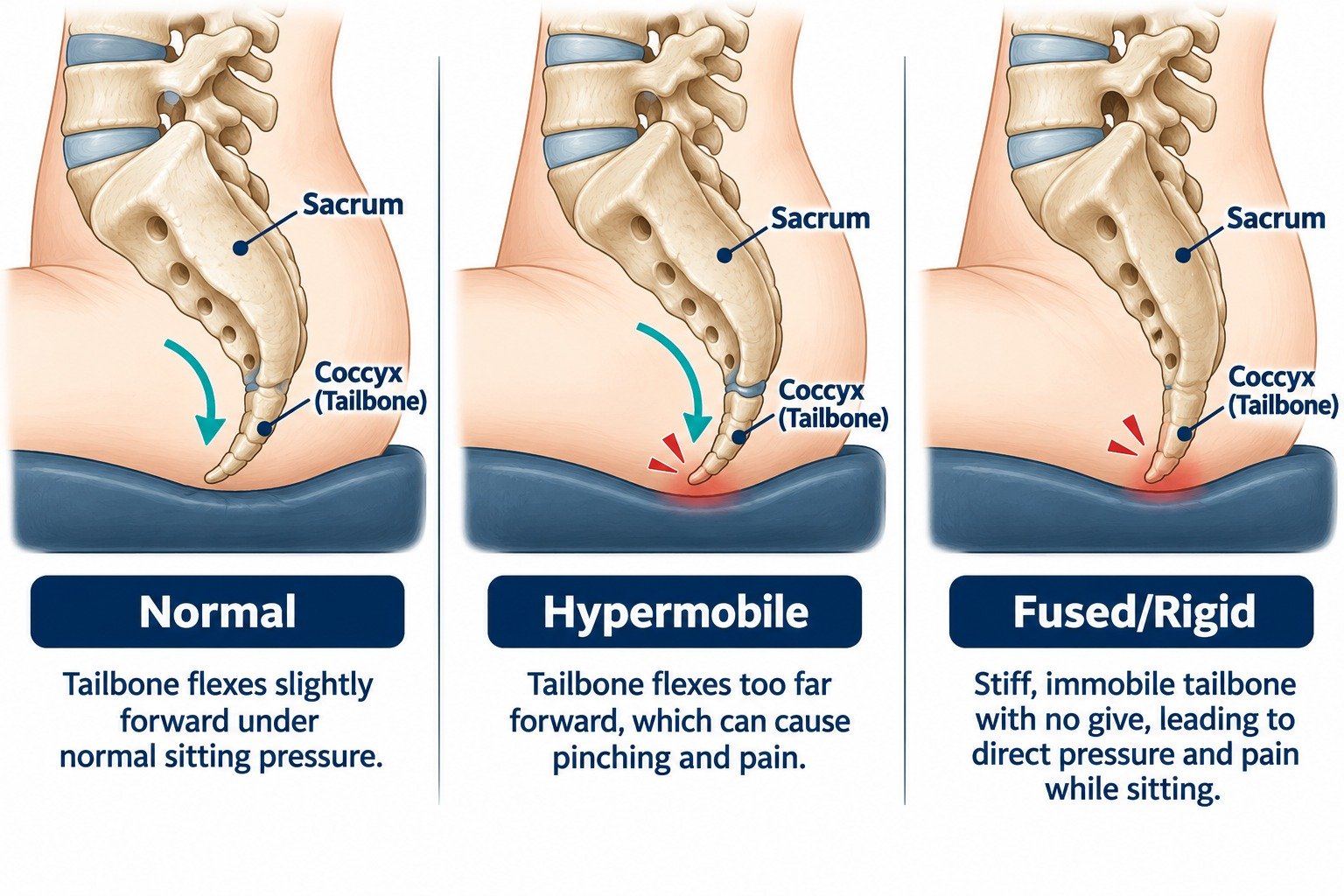
A hypermobile coccyx subluxes too far backward with sitting; a fused coccyx cannot flex at all — both patterns irritate the sacrococcygeal joint.
The Most Common Causes
सबसे आम कारण
అత్యంత సాధారణ కారణాలు
- Direct trauma — a fall onto the tailbone (slipping, missing a step) is one of the leading causes
- Childbirth — vaginal delivery can stretch or injure the sacrococcygeal joint, especially with a difficult labour
- Prolonged sitting — especially on hard or narrow surfaces, or leaning back while seated, which increases pressure on the coccyx
- Repetitive strain — cycling, rowing, or other activities that load the tailbone repeatedly
- Abnormal coccyx mobility — some tailbones are too mobile (hypermobile) and sublux backward with sitting; others fuse and become too rigid — both patterns can cause pain
- Idiopathic — in a meaningful proportion of patients, no single clear cause is found, and that does not mean nothing is wrong
📊 Coccydynia is roughly 5 times more common in women than men — the female pelvis and coccyx anatomy makes the joint more exposed to childbirth-related and posture-related strain. It is also more likely in people who are overweight, since more pressure is transferred onto the coccyx while sitting.
Rarely, tailbone pain is caused by infection, a bone lesion, or a tumour of the sacrococcygeal region — this is why a doctor examining unexplained tailbone pain will always check for other causes before assuming it is simple coccydynia.
What Does It Feel Like?
यह कैसा महसूस होता है?
ఇది ఎలా అనిపిస్తుంది?
How to recognise coccydynia
- Pain directly over the tailbone — sharp, dull, or aching, right at the very base of the spine
- Worse with sitting — especially on hard or narrow chairs, and especially prolonged sitting
- Worse moving from sitting to standing — a common trigger patients describe clearly
- Worse leaning back while seated — this increases direct pressure on the coccyx
- Tenderness when the area is pressed directly
- Occasional pain during bowel movements or, in women, during intercourse
Pain relief on standing or lying down, and a very localised area of tenderness right at the tailbone, are the two features that most reliably point to coccydynia rather than a lower back or hip problem.
When to See a Doctor Urgently
डॉक्टर से तुरंत कब मिलें
వైద్యుడిని వెంటనే ఎప్పుడు సంప్రదించాలి
Signs that this may not be simple coccydynia
⚠️ Seek prompt evaluation if you have: fever or feeling generally unwell alongside the pain · pain that is worse at night or does not ease with rest · unexplained weight loss · numbness, tingling, or weakness in the legs · loss of bladder or bowel control · a visible lump or skin changes near the tailbone. These can point to infection, a pilonidal cyst, nerve involvement, or — rarely — a tumour, and need a proper clinical work-up rather than home care.
Most people with these red flags do not turn out to have anything serious — but they are exactly the reason a doctor examines and, if needed, images the area before labelling pain as "just coccydynia."
Self-Care First
पहले स्व-देखभाल
మొదట స్వీయ-సంరక్షణ
What genuinely helps most patients before any procedure
The good news: the majority of coccydynia cases improve substantially with simple measures within a few weeks to a few months, without needing any injection or procedure.
- A wedge-shaped or "donut" coccyx cushion — takes direct pressure off the tailbone while sitting
- Avoid prolonged sitting and take standing breaks, especially on hard surfaces
- Sit leaning slightly forward rather than reclining back, to reduce load on the coccyx
- Ice in the first few days after an injury, then heat for ongoing stiffness
- Simple anti-inflammatory medication, used short-term and as advised by your doctor
- Stool softeners if bowel movements aggravate the pain
- Gentle stretching and pelvic floor relaxation exercises — there is good clinical evidence supporting stretching and manual manipulation for coccydynia
💡 If you sit for long hours at work, a coccyx cushion is genuinely one of the highest-value, lowest-cost things you can do — most patients notice a difference within days.
Treatment Options — In Order
उपचार के विकल्प — क्रम में
చికిత్స ఎంపికలు — వరుసగా
From simple self-care to procedures, only if needed
Treatment for coccydynia follows a clear ladder — we always start at the top, and only move down if a stage genuinely fails to help after a fair trial.
Conservative care First-line
रूढ़िवादी उपचार प्राथमिक उपचार
సంప్రదాయ చికిత్స మొదటి-వరుస
Cushioning, activity modification, anti-inflammatories, and physical therapy (stretching and manual manipulation of the coccyx have supporting clinical evidence). This resolves the large majority of cases without any procedure.
Local anaesthetic ± steroid injection
लोकल एनेस्थेटिक ± स्टेरॉयड इंजेक्शन
లోకల్ అనస్థీషియా ± స్టెరాయిడ్ ఇంజెక్షన్
An injection around the sacrococcygeal joint, useful both to confirm the diagnosis and to treat it. Studies report roughly 60% success with injection alone, rising to around 85% when combined with manual manipulation of the coccyx.
Ganglion impar block
गैंग्लियन इम्पार ब्लॉक
గాంగ్లియన్ ఇంపార్ బ్లాక్
A precise, image-guided injection targeting the nerve cluster just in front of the coccyx. This is particularly effective for coccydynia without a clear cause, with studies reporting meaningful pain reduction (roughly 50–70%) that can last for months. It is a well-tolerated outpatient procedure.
Pulsed radiofrequency of the ganglion impar
गैंग्लियन इम्पार का पल्स्ड रेडियोफ्रीक्वेंसी
గాంగ్లియన్ ఇంపార్ పల్స్డ్ రేడియోఫ్రీక్వెన్సీ
For pain that responds to a ganglion impar block but keeps returning, pulsed radiofrequency can extend that relief for refractory cases, with an evidence base similar in effect to repeat blocks.
Coccygectomy (surgical removal of the coccyx) Last resort
कॉक्सिजेक्टॉमी (कॉक्सिक्स का सर्जिकल निष्कासन) अंतिम विकल्प
కాక్సిజెక్టమీ (కాక్సిక్స్ శస్త్రచికిత్స ద్వారా తొలగింపు) చివరి ఎంపిక
Reserved for chronic pain (typically after 6–12 months) that hasn't responded to the steps above. When patients are correctly selected, published success rates are around 80–90% — but the procedure carries a notably higher infection risk than most orthopedic procedures, and recovery takes patience. This is why every non-surgical option is given a genuine trial first.
📋 Evidence note: A 2022 systematic review (Global Spine Journal) and multiple case series consistently support this staged approach — conservative care and manipulation first, image-guided injections for those who don't settle, and coccygectomy reserved for well-selected, refractory cases.
Dr. Sumit's Advice
डॉ. सुमित की सलाह
Dr. సుమిత్ సలహా
What I tell every patient who comes to me with tailbone pain
"Tailbone pain looks alarming because it sits right on the spine, but it is rarely a serious problem. Most patients I see improve with a cushion, posture changes, and a few weeks of patience — before we even discuss an injection. The step most people skip is a proper examination to rule out the rarer causes. Once we've confirmed it's straightforward coccydynia, we go step by step, and surgery is genuinely the last conversation, not the first."
— Dr. Sumit Dubewar · DABRM (USA) · Secunderabad
Consultation Information
परामर्श जानकारी
సంప్రదింపు సమాచారం
Dr. Sumit Dubewar consults at ONE Healthcare Clinic, Tirumalagiri, Secunderabad. Phone: +91 9370498182.
Clinic Appointments